The ALIF Advantage
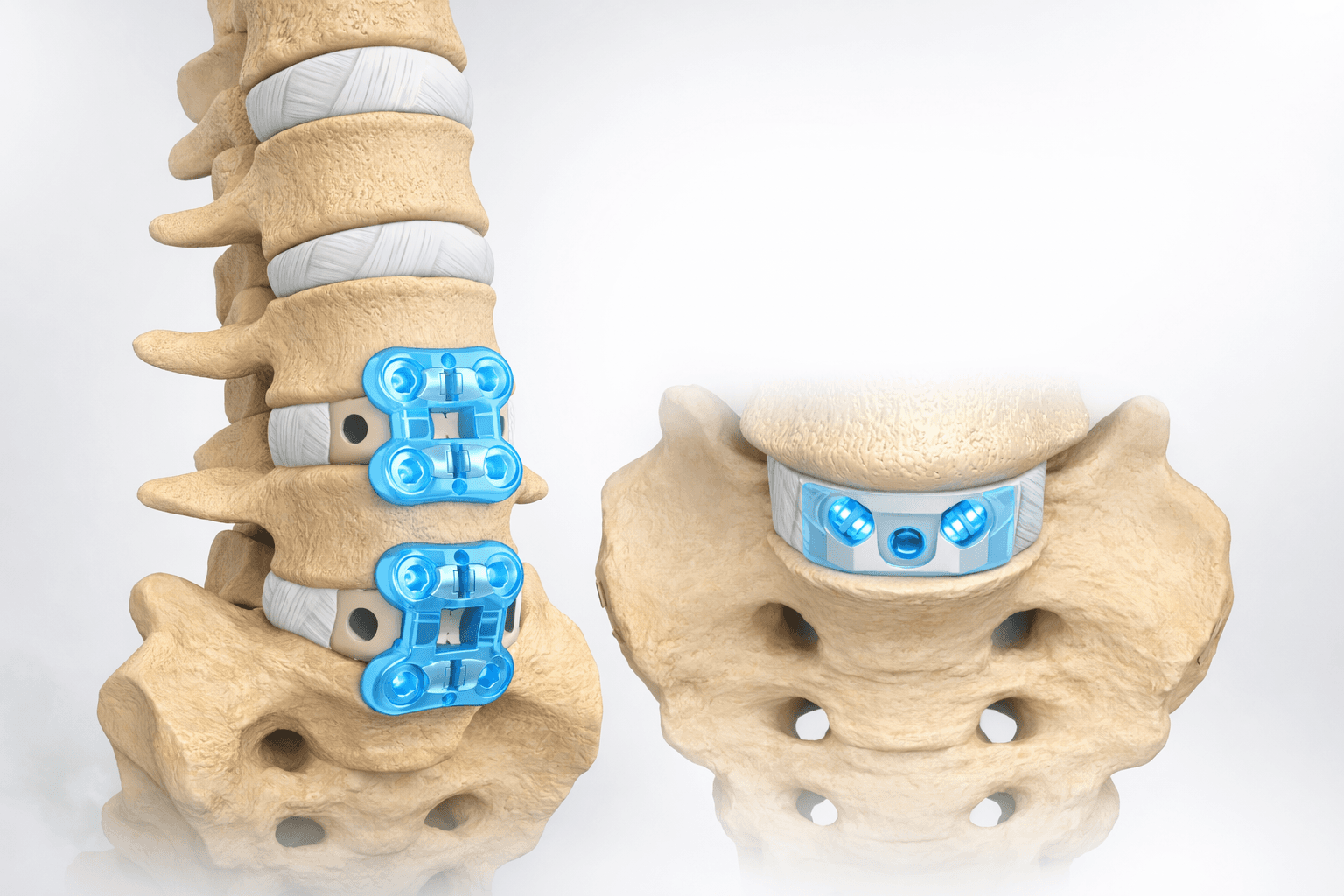
Approach: The surgeon reaches the spine through a small incision in the lower abdomen.
Muscle Preservation: By going through the front, we avoid cutting or retracting the major muscles of your back.
Superior Alignment: This approach allows for a larger implant to restore the natural curve of your spine.
Ideal For: Patients with degenerative disc disease at the L4-L5 and L5-S1 levels.
Protecting Your Back by Approaching from the Front
If you are dealing with chronic lower back pain or a collapsed disc, you have likely heard of spinal fusion. However, for many active patients, the traditional "back-entry" surgery can be a source of anxiety due to the impact on back muscles.
Anterior Lumbar Interbody Fusion (ALIF) is a specialized procedure that changes the way we think about spine health. By approaching the spine from the anterior (front) of the body, we can stabilize the vertebrae while keeping your vital "posterior chain" muscles intact.
What is ALIF Surgery?
ALIF stands for Anterior Lumbar Interbody Fusion. To understand why this procedure is so effective, it helps to look at the anatomy of your lower back. Your lumbar spine (L1 through L5) and your sacrum (S1) carry the weight of your entire upper body. When a disc at the L4-L5 or L5-S1 level collapses, it can pinch nerves and cause debilitating back pain or sciatica.
In an ALIF procedure, the surgeon reaches these discs through a small, horizontal incision in the lower abdomen. This "front door" approach allows the spine surgeon to remove the entire damaged disc and replace it with a high-tech spacer, or "cage," which is filled with bone graft material. Over the following months, your body heals these two vertebrae together into one solid, stable bone.
The Biomechanical Advantage: Why "Front" is Better for Your Back
If you look at a cross-section of the human body, the spine is located closer to the back, but the discs are actually quite deep. When a surgeon goes through the back (Posterior), they must navigate around the spinal cord and nerve roots to reach the disc.
By choosing the Anterior approach, we bypass the nerves entirely. This offers several key benefits:
Maximum Disc Height Restoration
Because the surgeon has a clear, unobstructed view of the disc space from the front, they can insert a much larger cage than they could from the back. This is crucial for "opening up" the windows where the nerves exit (the foramen). By restoring the full height of the disc, we can often relieve nerve pressure without ever touching the nerves themselves.
Restoring Your Lumbar Lordosis
"Lordosis" is the natural C-shaped curve of your lower spine. Many patients with chronic back pain have a "flat back" because their discs have collapsed. A major goal of ALIF is to restore this curve. By using a wedge-shaped cage from the front, we can "re-clock" the spine into its optimal athletic position. This is vital for patients who want to return to sports like golf or tennis, where spinal rotation is key.
The Team Approach: Why You Have Two Surgeons
One of the most common questions patients ask is why an "Access Surgeon" is involved. In an anterior lumbar interbody fusion, we use a team-based model for your safety.
The Access Surgeon: Usually a vascular or general surgeon, this specialist gently moves the abdominal contents and blood vessels to the side.
The Spine Surgeon: Once the path is clear, your spine surgeon performs the discectomy and inserts the fusion device.
This teamwork ensures that your vital organs and major blood vessels are handled by the person most qualified to protect them. This makes the procedure safer and highly precise.
ALIF vs. TLIF: Comparing Your Recovery Options
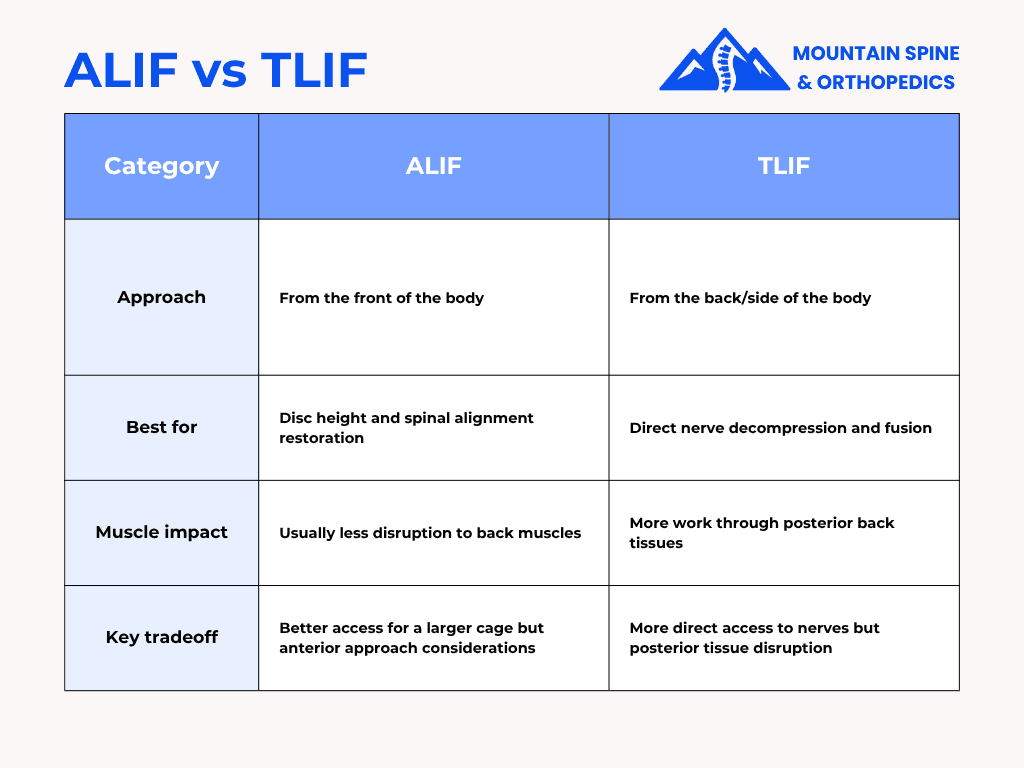
While TLIF (Transforaminal) is a common surgery performed through the back, ALIF is often the better choice for patients who want to maintain their core and back strength.
Muscle Impact: ALIF preserves the back muscles entirely. TLIF requires the surgeon to move or cut through those muscles to reach the spine.
Spine Alignment: ALIF allows for a wedge-shaped cage that better restores "lordosis," which is the natural inward curve of your lower back.
Fusion Surface: Because we go through the front, we can use a much larger cage, which provides a larger surface area for the bone to grow and fuse.
Preparing for Surgery: The Nicotine Rule
Success in the operating room starts with your preparation at home.
The most important rule is to stop all nicotine products. Nicotine constricts blood flow and significantly hinders the body's ability to grow new bone. If you use tobacco or vapes, your risk of a "non-union" (where the bones fail to fuse) increases dramatically. Most surgeons recommend being nicotine-free for at least six weeks before and after the procedure.
Addressing the "Vascular Fear"
It is natural to feel anxious when you hear that major blood vessels must be moved. However, statistics show that the risk of major vascular injury in a primary ALIF is extremely low (typically 1% to 2%). In the rare event that a minor nick occurs, the vascular surgeon is already right there to repair it immediately. This is why the "two-surgeon" model is the safest way to perform an anterior fusion.
The Recovery Timeline: What to Expect
Many patients worry about the pain after surgery. While you will feel soreness in your abdomen (similar to the feeling after a very intense core workout), the deep, stabbing back pain often begins to fade almost immediately.
The First 48 Hours
We want you standing and walking on the same day as your surgery. Walking helps prevent blood clots and "wakes up" your digestive system, which can be sluggish after abdominal surgery. You will likely wear a soft Velcro abdominal binder to support your core muscles while they heal.
Weeks 2 to 6
Most patients can return to light activity and desk work within a few weeks. You will be advised to avoid the "BLTs": Bending, Lifting (anything heavier than a gallon of milk), and Twisting.
Month 6 and Beyond
By the six-month mark, the bone graft is typically solidified. This is the point where many patients are cleared to return to more vigorous activities like golf, tennis, or running.
Start Your Path to a Pain-Free Life
ALIF surgery is a powerful tool for restoring the foundation of your spine. By choosing an approach that protects your muscles and restores your natural alignment, you are setting yourself up for a stronger, faster recovery.
Next Step: Get a Professional Opinion If you have an MRI and want to know if you are a candidate for this muscle-preserving approach, we are here to help. You can start with a free MRI review to see which treatment is right for your specific anatomy.
Frequently Asked Questions
Answers to the most common patient questions about this topic.
Is ALIF surgery considered a major surgery?
Yes, it is a major surgery requiring general anesthesia and a hospital stay of one to two nights. However, because it uses natural "planes" between tissues rather than cutting muscle, it is a minimally invasive approach.
How long does the procedure take?
A single-level ALIF usually takes between one and two hours. Extra stabilization with posterior screws may add time.
Can I live a normal life after a fusion?
Absolutely. The goal is to restore your quality of life. Once the fusion is mature, most patients return to full activity without the debilitating pain they had before.