If your mother, father, brother or sister has scoliosis, it is natural to wonder whether it is waiting for you, or for your children. The honest answer is more reassuring than most people expect, and it depends a great deal on which kind of scoliosis runs in your family.
Quick answer: is scoliosis genetic?
Partly. The most common kind, idiopathic scoliosis, clearly runs in families, and researchers have linked it to several genes. But no single gene causes it, and most close relatives of someone with idiopathic scoliosis do not have it themselves.
Other kinds work differently. Congenital scoliosis, which starts before birth, is usually not inherited. Degenerative scoliosis, the kind that appears in adults, comes mainly from uneven wear in the discs and joints of the spine. Genes influence how discs age, but how much they contribute to degenerative scoliosis itself is still uncertain.
Three kinds of scoliosis, and how much genes matter in each
Scoliosis is a sideways curve of the spine, usually with some twisting of the vertebrae, the bones that stack to form your spine. It is not one condition with one cause, which is why the genetics question has more than one answer.
Idiopathic scoliosis: the kind that runs in families
Idiopathic means doctors cannot point to a single cause. It is by far the most common type, it usually shows up around the growth spurt before and during the teenage years, and it affects about 2 to 3 percent of adolescents. This is the type with the clearest family link. According to the American Academy of Orthopaedic Surgeons, about 30 percent of patients with adolescent idiopathic scoliosis have a family history of the condition. Both boys and girls get it, but girls are more likely to develop curves large enough to need treatment.
Congenital scoliosis: a spine that formed differently before birth
Congenital scoliosis happens when one or more vertebrae do not form or separate normally while a baby is developing. Most cases are sporadic, meaning they appear in a family for the first time, and family studies show a low chance of it happening again to a brother or sister. Researchers have found genes involved in how the spine forms, but no simple inheritance pattern explains most cases.
Neuromuscular scoliosis: a curve caused by another condition
Some curves develop because of a condition that affects the nerves or muscles, such as cerebral palsy or muscular dystrophy. Whether this kind runs in a family depends on the underlying condition, not on the scoliosis itself.
Degenerative scoliosis: the adult kind
Degenerative scoliosis develops in adulthood as the discs and the small joints at the back of the spine wear unevenly, so the spine gradually starts to lean. Common contributors include degenerative disc disease, facet joint arthritis and osteoporosis, and it is most common after age 50. It is also far more common than many people realize. In one study of volunteers aged 60 and older who had never been told they had scoliosis, 68 percent had a curve of more than 10 degrees on X-ray.
What family and twin studies actually show
The evidence that idiopathic scoliosis has a genetic side comes from decades of studying families and twins. Here is what it says, in plain terms.
Close relatives have a higher rate
Family studies have found scoliosis in roughly 7 to 16 percent of the parents, children, brothers and sisters of people with idiopathic scoliosis. That is several times the rate in the general population. Read the other way, it also means most close relatives do not have it.
Identical twins share it more often
When one identical twin has idiopathic scoliosis, the other twin is more likely to have it than when the twins are not identical. Identical twins share all of their genes, so that difference points to genes playing a real part.
Genes explain part of the picture, not all of it
A large study of Swedish twins estimated that genetic factors account for about 38 percent of the variation in who develops idiopathic scoliosis. That figure describes a population, not your personal odds. It also means the rest comes from factors that are not inherited, or that researchers do not yet understand.
There is no single scoliosis gene
Scientists have linked several genes to idiopathic scoliosis. The finding repeated most often involves a region near a gene called LBX1. The common variants found so far each raise the risk only slightly, which is why having one does not mean you will develop a curve.
Is there a genetic test for scoliosis?
Not one that doctors routinely use today. A DNA-based test called ScoliScore was marketed to predict whether a teenager's curve would get worse, but studies in other populations could not reproduce its results, and it no longer appears to be commercially available.
For now, a family history is a reason to watch more closely. An X-ray, not a DNA test, is what shows whether a curve is there and how large it is.
If a parent, brother or sister has scoliosis: what to watch for
Knowing scoliosis runs in your family is useful mainly because it tells you what to look for, and when.
In children and teenagers
The signs are often easiest to see from behind:
- Uneven shoulders, or one shoulder blade sticking out more than the other
- Ribs that stand out more on one side
- An uneven waistline
- One hip higher than the other
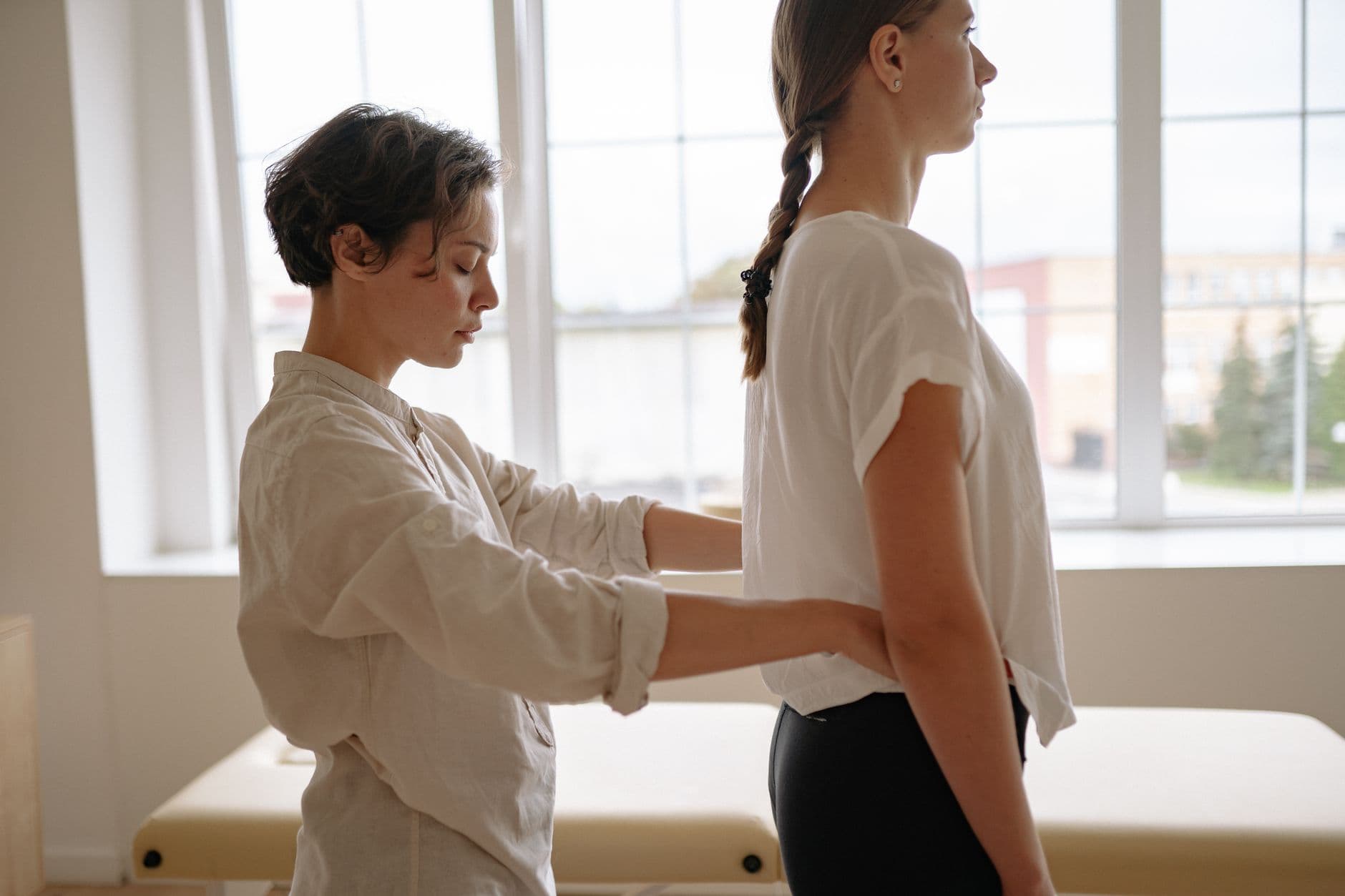
A simple check is the forward bend test. The child bends forward with feet together, knees straight and arms hanging, and the doctor looks from behind for a difference between the two sides of the ribs. Curves can worsen quickly during growth spurts, so a child with a family history should be checked by their own doctor at routine visits, and sooner if you notice any of these signs.
In adults
Adult curves more often announce themselves through symptoms than appearance:
- Lower back pain that gets worse the longer you stand or walk
- Pain that eases when you sit or bend forward
- A visible lean, or shoulders and hips that look uneven
- Leg pain, numbness or tingling, which can mean nerves are being pinched
- Back stiffness and fatigue
What a family history means if you are an adult
For most adults, the question is not whether you inherited scoliosis at birth, but whether a curve you already have is changing, or whether wear in your spine is starting a new one.
If you had a curve as a teenager
The size your curve reached when you stopped growing matters most. Once growth is finished, a curve rarely worsens quickly. Smaller curves, under about 30 degrees at the end of growth, tend not to get worse. Larger curves, particularly those over 50 degrees, can keep progressing slowly through adult life.
The long-term outlook is better than many people fear. A study that followed people with untreated idiopathic scoliosis for about 50 years found they had more back pain than their peers, but no increase in deaths, and most worked and managed daily life as well as people without scoliosis.
If a curve appears later in life
A new curve after 50 is usually degenerative, driven mainly by the condition of your discs and joints. How much genes contribute to this adult kind is still uncertain. Wear can also add to a mild curve you have had since your teens, which is why an old curve that never caused trouble can start to hurt in your 50s or 60s. For how curves are graded and when treatment moves from exercise and injections toward surgery, see our guide to adult scoliosis treatment and when surgery is needed.
When to see a spine specialist
See a spine doctor if you have a known curve and new or worsening back pain, a visible change in your posture, or pain, numbness or tingling in your legs. The same applies if a relative has scoliosis and you notice any of the adult signs above in yourself. If you notice the signs in a child or teenager, start with the child's own doctor. New weakness in your legs needs prompt medical attention rather than a routine appointment. Weakness in both legs, or a new change in bladder or bowel control such as trouble passing urine or leaking urine or stool, is an emergency, so go to an emergency room right away.
An adult curve is checked with standing full-length X-rays, which let the doctor measure the Cobb angle, the angle between the most tilted vertebrae at the top and bottom of the curve. An MRI is usually added when there are leg symptoms or when surgery is being considered. If a curve is progressing or pressing on nerves, adult scoliosis surgery may be discussed.
If you already have an MRI, Mountain Spine offers a free MRI review. If you have been told you need surgery for your curve and want another view before deciding, you can request a second opinion.
Frequently Asked Questions
Answers to the most common patient questions about this topic.
Is scoliosis hereditary?
Partly. Idiopathic scoliosis, the most common kind, runs in families, and about 30 percent of teenagers with it have a family history of the condition. But no single gene causes it, and most close relatives of someone with idiopathic scoliosis do not have it. Congenital scoliosis is usually not inherited, and degenerative scoliosis in adults comes mainly from wear in the spine, although how much genes contribute to it is still uncertain.
How common is scoliosis?
Idiopathic scoliosis affects about 2 to 3 percent of adolescents. Curves become more common with age. In one study of volunteers aged 60 and older who had never been told they had scoliosis, 68 percent had a curve of more than 10 degrees on X-ray.
How does scoliosis happen?
It depends on the type. Idiopathic scoliosis has no single known cause and appears to come from many genes combined with other factors. Congenital scoliosis starts before birth, when vertebrae do not form or separate normally. Neuromuscular scoliosis comes from conditions such as cerebral palsy or muscular dystrophy. Degenerative scoliosis develops in adults as the discs and joints of the spine wear unevenly.
How do you know if you have scoliosis?
Common signs are uneven shoulders, one shoulder blade sticking out more than the other, ribs that stand out more on one side, an uneven waist, or one hip higher than the other. In adults, back pain that worsens with standing or walking, a visible lean, or leg pain and numbness can also point to a curve. An X-ray confirms it and measures how large the curve is.
Can scoliosis kill you?
Scoliosis itself is rarely life-threatening. A 50-year follow-up of people with untreated idiopathic scoliosis found no increase in deaths compared with the general population, although they reported more back pain. Very large curves in the upper back can crowd the lungs and cause shortness of breath, which is one reason large curves are monitored and sometimes treated.
If I have scoliosis, will my children get it?
Their risk is higher than average, but most children of a parent with idiopathic scoliosis do not develop it. Because curves can grow quickly during growth spurts, tell your child's doctor about your history so their spine is checked at routine visits.