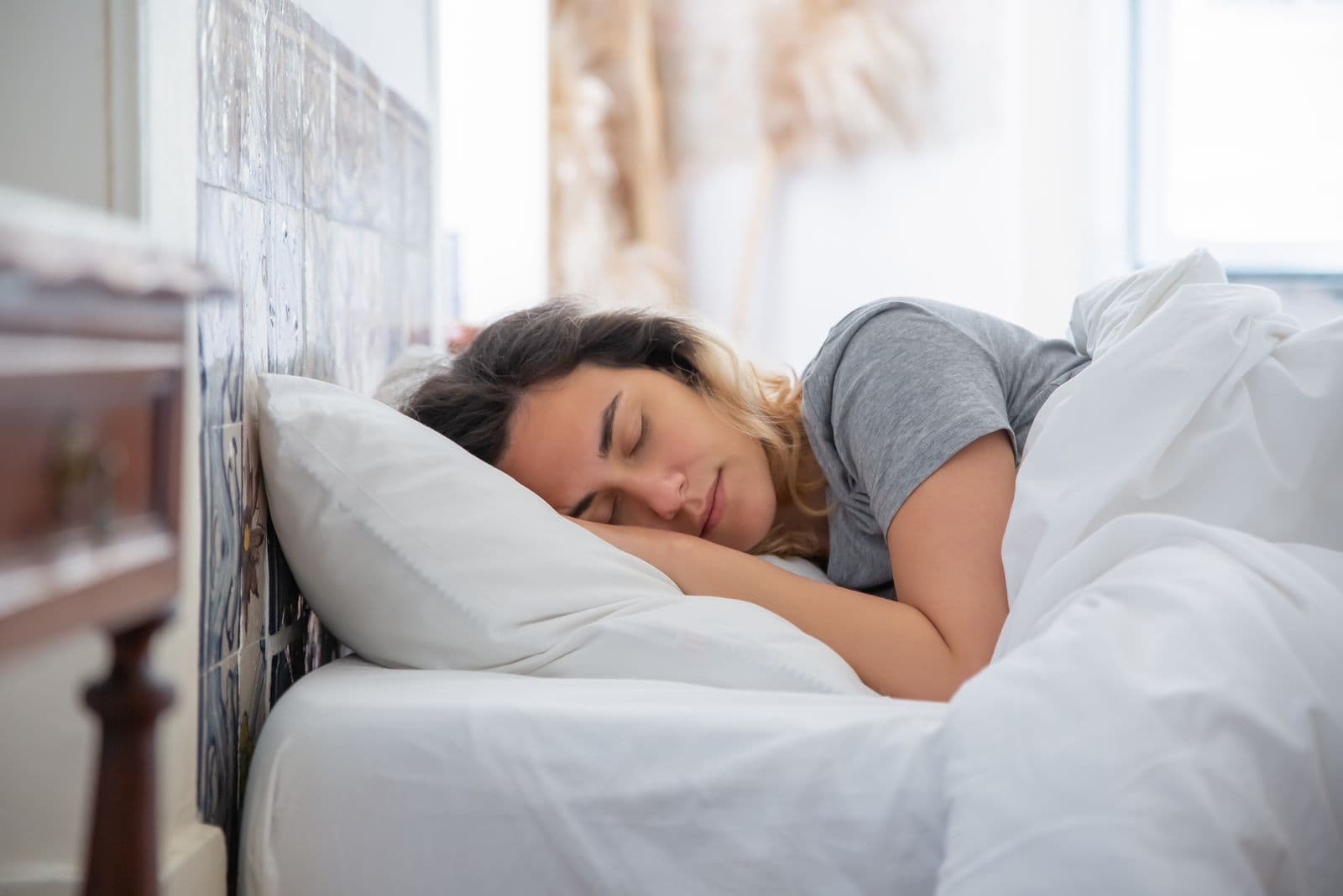
Sciatica has a way of getting louder the moment you lie down. The house is quiet, nothing distracts you, and every shift in bed sends the pain down your leg again. Small changes in how you lie can take pressure off your lower back, and they cost nothing to try tonight.
Quick answer: how to sleep with sciatica
Sleep on your side with your knees drawn up slightly and a pillow between your legs, or on your back with a pillow under your knees. Mayo Clinic recommends both for back pain: the side position can help align your spine, pelvis and hips, and a pillow under your knees may help relax your back muscles and keep the curve of your lower back. Avoid sleeping on your stomach if you can. Get in and out of bed by rolling to your side first, so your back does not twist.
If the pain keeps waking you night after night for more than a few weeks, that is a sign to have it examined rather than to keep buying pillows.
Why sciatica can feel worse at night
Sciatica is pain from an irritated nerve root in your lower back, most often pressed on by a herniated disc or squeezed by spinal stenosis, a narrowing of the canal the nerves run through. The pain follows the nerve, from the buttock down the back of the leg.
At night you stay in one position for hours, and some positions hold your lower back in a way that aggravates the nerve. There is also less to take your mind off the pain. That is why how you lie matters more at night than during the day.
The best sleeping positions for sciatica
These are the positions Mayo Clinic recommends for back pain. Try each for a few nights and keep the one that lets you sleep longest without waking in pain.
On your side, with a pillow between your knees
Lie on your side and draw your legs up slightly toward your chest. Put a pillow between your legs. Mayo Clinic says flexing your knees with a pillow between your legs can help align your spine, pelvis and hips and takes pressure off your spine. A full-length body pillow works too, if you prefer one.
On your back, with a pillow under your knees
Lie on your back and put a pillow under your knees. Mayo Clinic says this may help relax your back muscles and maintain the curve of your lower back. If you need more support, add a small rolled towel under your waist. Use a head pillow that keeps your neck in line with your chest and back.
On your stomach, only if nothing else works
Mayo Clinic says stomach sleeping can be hard on your back and suggests trying other positions if possible. If you cannot sleep any other way, put a pillow under your hips and lower stomach to reduce the strain.
Match the position to what is causing your sciatica
The two most common causes of sciatica respond differently to position, which is why the same advice helps one person and annoys another.
Spinal stenosis: leaning forward usually helps
The American Academy of Orthopaedic Surgeons (AAOS) says people with spinal stenosis often feel better when they lean forward or sit down, and that standing up straight or walking usually makes the pain worse. It also notes that leaning forward can increase the space available for the nerves. If stenosis is your diagnosis, a side position with your knees drawn up toward your chest is worth trying first.
Herniated disc: avoid long periods of sitting, and move with care
With a herniated disc, part of the disc presses on the nerve. AAOS notes that staying seated for long periods can put pressure on your spine and disks, and advises slow, controlled movement, especially when bending forward and lifting. If a tightly curled position makes your leg pain worse, straighten out a little or try your back with a pillow under your knees.
Not sure which you have?
You do not need to know before you start. Use comfort as your guide: if a position makes the pain run further down your leg, change it. If you never find one that works, an examination and, when needed, imaging can tell the causes apart, and that changes the treatment too. Our guide to bulging versus herniated discs explains what an MRI can and cannot show.
Which side should you sleep on?
Mayo Clinic's side-sleeping advice does not name a side, so try both. Some people are more comfortable with the painful leg on top, others the opposite. What matters more is the pillow between your knees, so your top leg does not drop forward and twist your pelvis.
Your mattress and pillows
Harder is not automatically better. In a randomized trial of 313 adults with chronic low back pain published in The Lancet in 2003, people who slept on a medium-firm mattress had less pain in bed and less disability after 90 days than people on a firm mattress. That trial left out people whose pain spread into the leg, so it is not proof for sciatica, but it is a good reason not to swap to a very hard bed.
Before buying anything, try pillows first: one between your knees, one under them, or a body pillow.
How to get in and out of bed without a jolt of pain
For many people the worst moment of the night is the first move in the morning. The log roll keeps your trunk straight, so your back does not bend and twist at the same time. These steps follow Kaiser Permanente's patient guide.
- Lie on your side, facing the direction you want to get out of the bed.
- Use your arms to help raise your upper body as you lower your legs to the floor. Keep your trunk straight as you move.
- Sit up straight on the side of the bed.
- Use your hands to help push yourself up to standing.
To get into bed, do the same steps in reverse: sit on the side of the bed first, then lower yourself onto your side without twisting.
A short routine for the day and the evening
- Keep moving during the day. The NHS advises carrying on with your normal activities as much as possible and starting gentle exercise as soon as you can, and not sitting or lying down for long periods. AAOS advises no more than 1 to 2 days of bed rest for a herniated disk.
- Heat. The NHS suggests holding heat packs to the painful areas.
- Break up long evenings sitting. This matters most if you have a disc problem.
- Set up the bed before you lie down. Put the knee pillow where you need it, so you are not twisting to find it in the dark.
Go to an emergency room now if you have these
Sciatica on its own is not an emergency. These signs can point to a serious back problem that needs treatment in hospital as soon as possible. Go to an emergency room or call 911 if you have:
- Numbness around or under your genitals, or around your bottom
- Trouble starting to pee, being unable to pee, or not being able to control when you pee, if that is not normal for you
- Not noticing when you need to poo, or not being able to control it, if that is not normal for you
- Sciatica on both sides
- Weakness or numbness in both legs that is severe or getting worse
This list follows the NHS sciatica guidance. Do not drive yourself.
When night pain means it is time to see a spine specialist
Most sciatica settles. The NHS says it usually gets better in a few weeks to a few months, and AAOS says most people with a herniated disk are free of symptoms by 3 to 4 months. Our guide to how long sciatica lasts goes through the timeline in detail.
See a doctor if the pain has not improved after a few weeks of home care, is getting worse, or is stopping you from doing your normal activities.
An evaluation looks for where the nerve is being pressed and why. Care usually starts with physical therapy and activity changes. When pain persists, an epidural steroid injection may be an option; see how long an epidural steroid injection lasts. Surgery is considered for a smaller group, and our guide to sciatica surgery explains when.
If sciatica is costing you sleep, Mountain Spine & Orthopedics can evaluate your back and leg pain and explain your options, starting with the least invasive ones.
Frequently Asked Questions
Answers to the most common patient questions about this topic.
What is the best sleeping position for sciatica?
For most people, lying on your side with your knees drawn up slightly and a pillow between your legs, or lying on your back with a pillow under your knees. Mayo Clinic recommends both for back pain. The side position can help align your spine, pelvis and hips, and a pillow under your knees may help relax your back muscles and keep the curve of your lower back. Try both and keep the one that lets you sleep longest without waking in pain.
Should I sleep on my stomach with sciatica?
Try not to. Mayo Clinic says stomach sleeping can be hard on your back. If it is the only way you can fall asleep, put a pillow under your hips and lower stomach to reduce the strain.
Is a firm mattress better for sciatica?
Not necessarily. In a randomized trial of 313 adults with chronic low back pain published in The Lancet in 2003, people given a medium-firm mattress had less pain in bed and less disability after 90 days than people given a firm one. That trial left out people with pain spreading into the leg, so it does not prove the same for sciatica, but it is a reason not to assume harder is better.
Is walking good for sciatica?
Usually, yes. NHS guidance is to carry on with your normal activities as much as you can and start gentle exercise as soon as possible, and AAOS advises only 1 to 2 days of bed rest for a herniated disk. If you have spinal stenosis, standing straight or walking can make the pain worse, and leaning forward, for example on a shopping cart, often helps.
When should I see a doctor for sciatica that keeps me up at night?
See a doctor if the pain has not improved after a few weeks of home care, is getting worse, or is stopping you from doing your normal activities. Go to an emergency room right away if you have numbness around your genitals or bottom, trouble controlling your bladder or bowels, sciatica in both legs, or weakness or numbness in both legs that is severe or getting worse.
Can sciatica be cured permanently?
Most sciatica settles on its own. The NHS says it usually gets better in a few weeks to a few months, and AAOS says most people with a herniated disk are free of symptoms by 3 to 4 months. When pain lasts, treatment such as physical therapy, an epidural steroid injection or, for a smaller group, surgery aims to take pressure off the nerve. No treatment can promise sciatica will never come back.