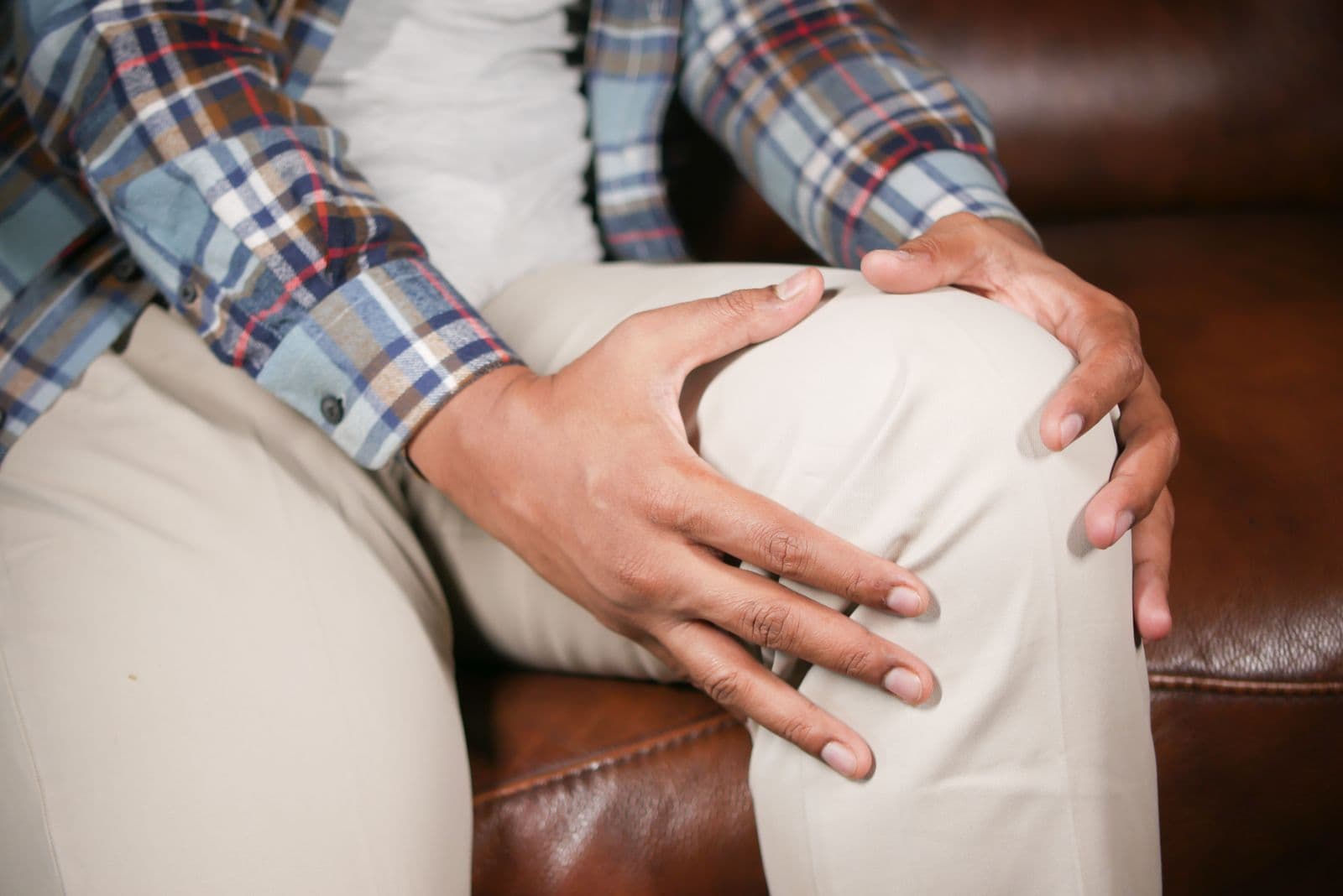
If the back of your knee hurts every time you straighten your leg, common causes include a torn meniscus, a Baker's cyst, an irritated hamstring tendon, a posterior cruciate ligament (PCL) injury, or arthritis. Most of these are not emergencies, but one cause, a blood clot, is. This guide explains how the causes differ, what you can do first, and when it is time to have the knee examined.
Quick answer: why does the back of my knee hurt when I straighten my leg?
Straightening your leg pulls the structures at the back of the knee tight and presses on anything swollen there. That is why a meniscus tear, a fluid-filled Baker's cyst, a strained hamstring tendon, a PCL injury or arthritis can all make full extension painful.
One cause needs urgent care: a blood clot (deep vein thrombosis) in the leg. If your calf is swollen, warm, red or tender, get medical care right away. If you also have trouble breathing or chest pain, call 911.
What sits at the back of your knee
The hollow behind your knee is called the popliteal fossa. Several structures pass through or sit close to it:
- The hamstring tendons, which attach the muscles at the back of your thigh to the bones below the knee.
- The posterior cruciate ligament (PCL), inside the knee just behind the ACL. It keeps your shinbone from sliding too far backward.
- The menisci, two C-shaped pads of cartilage that cushion the joint between the thighbone and shinbone.
- The popliteal vein and artery, the main blood vessels running behind the knee.
Pain when you straighten the leg usually means one of these is injured, inflamed or under pressure.
6 common causes
Each cause tends to feel a little different. Use these descriptions to have a clearer conversation with your doctor, not to diagnose yourself.
1. A torn meniscus
A meniscus can tear with a sudden twist or pivot, often in sports, or slowly wear and tear with age. According to the American Academy of Orthopaedic Surgeons, common symptoms include pain, stiffness and swelling, catching or locking, the knee giving way, and not being able to move the knee through its full range of motion. Trouble fully straightening the knee is one of the clues that points toward a torn meniscus.
2. A Baker's cyst
A Baker's cyst is a fluid-filled swelling behind the knee. It is usually linked to a problem inside the joint, such as arthritis or a cartilage tear, that makes the knee produce extra fluid. It can feel like a soft lump with tightness behind the knee, and it is often more noticeable when the leg is fully straight. Some cysts cause no symptoms at all.
3. A strained or irritated hamstring tendon
Overuse can irritate the hamstring tendons where they cross the knee, and a sudden sprint or kick can strain or slightly tear them. One of them, the biceps femoris, attaches on the outer side, so pain from it is often felt on the outer back of the knee. Stiffness, tenderness, some swelling and pain when you straighten the leg are typical.
4. A PCL injury
The PCL usually takes a strong force to injure, such as a bent knee hitting a car dashboard in a crash or a hard fall onto a bent knee. The AAOS describes pain with swelling that comes on quickly after the injury, a stiff knee, difficulty walking, and a feeling that the knee may give out. More detail is on our PCL tear page.
5. Arthritis
In osteoarthritis, the cartilage that lines the joint wears down. In rheumatoid arthritis, the joint lining becomes inflamed. Either can cause pain and stiffness that may be worse when you straighten the leg, and extra joint fluid can collect at the back of the knee, which is also how a Baker's cyst can form.
6. A blood clot (deep vein thrombosis)
A clot can form in the deep vein that runs behind the knee. According to the CDC, signs include swelling, pain or tenderness, warmth, and redness or discoloration in the leg, and about half of people with DVT have no symptoms at all. A clot can travel to the lungs, which is a medical emergency. This is the one cause on this list you should never wait out.
Clues that can point to one cause or another
These patterns are not a diagnosis, and several causes can happen together. A Baker's cyst often comes from a meniscus tear or arthritis, for example. But they help you tell your doctor what matters:
- The knee catches, locks or will not fully straighten: often a meniscus tear.
- A soft bulge behind the knee that feels tight when the leg is straight: often a Baker's cyst.
- Pain on the outer back of the knee after running or sprinting: possibly a hamstring tendon.
- Fast swelling and a wobbly knee after a fall or a blow to the front of the knee: possibly a PCL injury.
- Slow, gradual stiffness that is worse in the morning or after rest: often arthritis.
- A swollen, warm, red or tender calf: possibly a blood clot. Get medical care right away.
What you can do in the first few days
If there are no red flags and the pain followed a minor strain, the first steps are simple. Many knee injuries, including many meniscus tears, are first treated with the RICE approach the AAOS describes: rest, ice, compression and elevation. Avoid the movement that triggers the pain, such as deep squats, kneeling or running, and do not push through pain to force the knee straight.
Over-the-counter anti-inflammatory medicine can help some people, but check with your doctor or pharmacist first if you have stomach, kidney or heart problems, or take a blood thinner.
Home care is for mild, improving pain. It is not a way to wait out a knee that locks, gives way or keeps swelling.
Go to the emergency room now if you notice
- Swelling, warmth, redness or tenderness in your calf or lower leg, especially on one side
- Sudden trouble breathing, a fast or irregular heartbeat, or chest pain that is worse when you breathe in or cough. Call 911.
- Coughing up blood, or feeling lightheaded or faint
- A knee that suddenly cannot bear any weight after an injury, or looks out of shape
A burst Baker's cyst can cause calf pain and swelling that look very much like a blood clot. Doctors usually tell the two apart with an ultrasound, so do not assume a swollen calf is just the cyst.
When to see an orthopedic specialist
Make an appointment if:
- your knee catches, locks or gives way
- you cannot fully straighten it
- it swelled up after a twist, fall or blow
- you can feel a lump behind the knee
- the pain is not getting better with rest, or keeps coming back
An early exam matters because the right treatment depends entirely on the cause. Rest helps a strained tendon, but it will not unlock a knee blocked by a torn piece of meniscus.
What the evaluation looks like
An orthopedic visit starts with how the pain began and what makes it worse. The doctor then examines both knees, checking where it is tender, how far it bends and straightens, and whether the ligaments are stable. For a suspected meniscus tear, specific tests such as the McMurray test twist and bend the knee to see whether it catches or hurts.
Imaging depends on what the exam suggests:
- X-rays do not show a meniscus or ligament, but they show arthritis and rule out a bone injury.
- MRI is the preferred way to see meniscus tears and ligament injuries such as a torn PCL.
- Ultrasound can show a Baker's cyst, and it is the usual test when a blood clot needs to be ruled out.
Treatment depends on the cause
Most causes of pain behind the knee start with non-surgical care. Surgery is for specific problems that do not settle, or for injuries that will not heal on their own.
Meniscus tears
Many tears are treated first with rest, ice, anti-inflammatory medicine and physical therapy, and a corticosteroid injection can ease pain and swelling (see cortisone shots for knee pain). If symptoms continue, or the knee truly locks, a surgeon may recommend arthroscopic knee surgery, either trimming the torn piece or stitching the tear. Our post Do you need surgery for a torn meniscus? walks through that decision, and How successful is arthroscopic knee surgery? explains when it helps and when it does not.
Baker's cysts
A cyst that causes no symptoms may need no treatment. Otherwise, treating the problem behind it, such as arthritis or a meniscus tear, often settles it. A cyst can be drained, but it can come back if the underlying cause is not treated. Surgery to remove it is considered when it keeps returning and other treatments have not worked.
Hamstring tendon problems
These usually improve with rest, cold packs, a gradual return to activity and physical therapy that rebuilds strength and flexibility.
PCL injuries
A PCL injury on its own often heals well without surgery, with a brace, physical therapy to strengthen the thigh muscles and, early on, crutches. Surgery to rebuild the ligament with a graft is usually reserved for injuries that tear several ligaments at once, or for a knee that stays unstable or painful.
Arthritis
Treatment focuses on easing pain and keeping the knee moving: low-impact exercise such as cycling or swimming, physical therapy, anti-inflammatory medicine and, for some people, injections. Surgery is considered when these stop working.
Your next step
Pain behind the knee when you straighten your leg is common and usually treatable without surgery, but only once you know the cause. The orthopedic specialists at Mountain Spine & Orthopedics evaluate knee pain at our offices. They examine the knee, order the right imaging, and walk you through options from physical therapy and injections to arthroscopic surgery when it is the right tool. If your knee catches, locks, gives way or simply is not getting better, book an evaluation.
Frequently Asked Questions
Answers to the most common patient questions about this topic.
Why does the back of my knee hurt when I straighten my leg?
Straightening the leg stretches and squeezes the structures at the back of the knee. Common causes include a torn meniscus, a Baker's cyst, a strained or irritated hamstring tendon, a posterior cruciate ligament (PCL) injury and arthritis. A blood clot in the leg can also cause pain behind the knee, so calf swelling, warmth or redness needs prompt medical care.
What does a torn meniscus look like on the outside?
Often there is not much to see. A torn meniscus can cause swelling and stiffness, but the main signs are things you feel: pain, catching or locking, the knee giving way, and not being able to move it through its full range of motion. An exam and usually an MRI confirm it. Our post Do you need surgery for a torn meniscus? covers what comes next.
Can a torn meniscus heal on its own?
Many meniscus tears are treated without surgery at first, especially when the knee is not locking or badly swollen. Rest, ice, compression, elevation, anti-inflammatory medicine and sometimes an injection can ease the pain. Whether the tear itself heals depends on where it is and what kind of tear it is. If symptoms continue, a doctor may suggest arthroscopic surgery.
Is a Baker's cyst serious?
Usually not, but it is worth finding out why it formed, because it often points to another problem in the knee, such as arthritis or a torn meniscus. Treating that cause often settles the cyst. If a cyst bursts, it can cause calf pain and swelling that looks like a blood clot, so those symptoms should be checked promptly rather than assumed to be the cyst.
When should I see a doctor for pain behind my knee?
Go to the emergency room right away for calf swelling, warmth or redness, or for trouble breathing or chest pain. See an orthopedic specialist if your knee locks, catches or gives way, if it swelled after an injury, if you cannot fully straighten it, or if the pain is not getting better with rest.