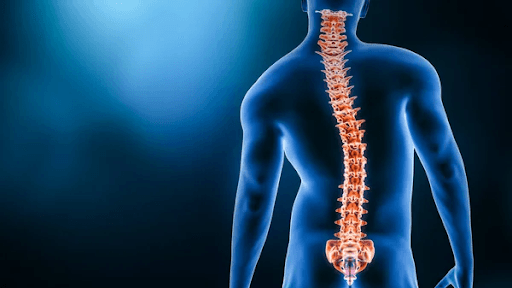
Most adults who learn they have scoliosis are handed a number: a curve measured in degrees, and a recommendation that seems to follow from it. The number matters, but in adults it decides far less than most patients are told, because many adult curves, especially in older adults, form for different reasons than they do in children.
Here is what actually determines whether an adult curve needs surgery, and what a specialist should be checking before anyone recommends one.
Quick answer: what actually decides scoliosis surgery
- The degree alone does not decide it. In adults, the same curve angle can mean very different things depending on balance, nerve involvement and whether it is changing.
- Four findings carry more weight than the measurement: spinal balance, nerve compression, loss of function, and documented progression.
- Many adult curves never need surgery. Curves that are not producing significant symptoms are usually monitored, not operated on.
- Standing imaging matters. A curve behaves differently under load, and a scan taken lying down will not show how the spine is actually carrying weight.
- Get emergency care immediately for new or rapidly worsening leg weakness, or any change in bladder or bowel control.
Why the curve angle decides less than you think
In adolescent scoliosis, the curve angle is a reasonably good guide. The spine is still growing, curve size and remaining growth help estimate the risk of progression, and surgical thresholds are relatively well established.
Adult degenerative scoliosis is a different condition that happens to share a name. It is not the same as a curve that began in adolescence and kept progressing into adulthood, which is a different situation that this post does not cover.
Adult degenerative scoliosis typically appears after age 50, in spines that were previously straight. The discs and facet joints of the lower back wear unevenly, one side of a segment loses height faster than the other, and the spine begins to tilt where it never did before. Repeated across several segments over years, the accumulated tilt becomes a measurable curve.
Because it forms differently, it behaves differently. A 40-degree curve in a 62-year-old with good spinal balance and no nerve compression is a very different clinical situation than a 25-degree curve in someone whose trunk has shifted forward and who can no longer walk to the end of the block.
Evaluating an adult curve starts from a straightforward premise: the spine is a load-bearing structure. The size of the curve still counts, but it is only one input. What matters just as much is whether the structure is still balanced, whether it is carrying load without compressing anything, and whether it is changing. The curve angle alone does not answer those three questions.
The four findings that actually determine it
Taken together, these four findings carry more weight than the angle on the report.
1. Balance
Balance is whether the trunk is still centered over the pelvis.
This is assessed on standing full-length imaging, not lying-down scans. A curve behaves differently under load. Lying down unloads the spine, so a curve can measure smaller than it does under load, and balance problems can be hidden.
When balance is lost, the body compensates by bending the knees and tilting the pelvis backward, and the trunk often pitches forward anyway. Those compensations take extra effort and contribute to fatigue, difficulty standing upright, and the sense of being pulled off-center.
2. Nerve involvement
This is whether the curve has narrowed the openings where nerve roots exit the spine.
As a degenerative curve develops, those openings can narrow and compress the nerves running to the legs. That produces:
- Leg pain, sometimes as noticeable as the back pain or more so
- Numbness or tingling in the leg or foot
- Weakness in the leg
- Symptoms that worsen with standing and walking, and ease with sitting
These leg symptoms are easy to mistake for ordinary sciatica or aging. If you want the detail on that mechanism, see sciatica and nerve pain and spinal stenosis.
3. Function
Function is what you can no longer do.
- How long you can stand through a workday
- Whether you can still travel comfortably
- How far you get on foot before you have to stop
- Whether you are avoiding activities you used to do without thinking
Surgeons treat declining function as more meaningful than any single measurement, because it describes what the curve is actually costing. A curve that has not changed in five years but has quietly cut your walking distance in half is telling you something a protractor cannot.
4. Progression
Progression is whether the curve is documented to be getting worse.
This one is important because it cannot be assessed from a single study. Progression requires comparison imaging, an earlier X-ray measured against a current one. A curve that has been stable for a decade and a curve that has advanced ten degrees in two years may measure identically today and mean entirely different things.
This is why bringing your prior imaging to an appointment matters more than most patients realize.
A finding that is easy to dismiss as coincidence
One observation is easy to write off as ordinary aging.
You can no longer walk through a store or an airport concourse, but leaning forward on the cart, or resting on a counter, makes it noticeably better.
That is not necessarily a coincidence, and it is not simply fatigue. Leaning forward opens up the space around the nerves in the lower spine, which can temporarily relieve compression. It is a recognized pattern of nerve compression, often called neurogenic claudication, and it is worth having evaluated rather than putting down to ordinary aging.
If that describes your experience, it is worth an evaluation.
Get emergency care now if you have these
Go to an emergency room rather than waiting for an appointment if you develop:
- New or rapidly worsening weakness in a leg
- Any change in bladder or bowel control
- Numbness in the groin or inner thighs
- Severe new pain after a fall, particularly with known low bone density
These are not "wait and see" symptoms.
See a spine specialist soon if you notice these
- Leg pain, numbness or tingling that worsens with walking and eases when you sit
- A shrinking distance you can stand or walk before stopping
- Relief from leaning forward on a cart, counter or walker
- A visible change in posture, shoulder height, waistline or trunk balance
- Height loss
- Back pain that is progressively worsening rather than coming and going
- A recommendation for deformity surgery that you want reviewed before proceeding
Wanting a second look before a deformity operation is entirely reasonable.
What a scoliosis evaluation will check
A thorough adult scoliosis evaluation is not a glance at an X-ray. It should cover:
- Curve history and symptom pattern: when it was found, what has changed, what makes it better or worse
- Standing and walking tolerance: measured in real terms, not "does it hurt"
- Posture and alignment: shoulder and pelvic balance, trunk shift, gait
- Neurological testing: strength, sensation and reflexes in both legs
- Standing full-length imaging: to evaluate balance under load
- Comparison with prior imaging: to establish whether the curve is progressing
- Advanced imaging where indicated: MRI or CT when nerve compression is suspected or surgery is being planned
- Bone health: because it affects what surgical options are appropriate
The appointment should end with a clear answer to three questions: what is causing your symptoms, what can be monitored, and whether surgery deserves consideration at all.
How to choose a scoliosis doctor
Four questions worth asking before you commit to a plan:
- Will standing full-length imaging be taken, rather than only lying-down scans?
- Will my prior imaging be compared to assess whether the curve is progressing?
- Does the surgeon perform both decompression and correction, so the full range of options is available in one place?
- What specifically would rule surgery out in my case?
That fourth question is the most useful one you can ask. Understanding what would make you a poor candidate is the fastest way to understand how a recommendation was reached.
Been told you need scoliosis surgery?
A second opinion reviews your imaging and symptoms independently. Many adult curves can be monitored rather than corrected.
Request a second opinion or call (561) 223-9959.
What treatment looks like
Treatment follows from which of the four findings are present, not from the curve angle alone.
When surgery is not needed
Many adults with measurable curvature need monitoring only. Where symptoms are present but not disabling, options include:
- Activity modification based on what actually triggers symptoms
- Medication review and pain management
- Targeted injections when a specific pain source has been confirmed
- Repeat standing imaging at intervals to watch for progression
When correction is warranted
Scoliosis surgery is not one operation.
- Decompression alone may be considered in selected patients when nerve compression is the main problem, the curve is small and the spine is stable with acceptable alignment.
- Alignment correction with instrumented spinal fusion is used when balance must be restored and the spine stabilized.
Candidacy for fusion depends on spinal balance, bone quality, the number of levels involved, overall health and how much the symptoms limit daily life, not on curve size alone.
What to bring to your appointment
- Prior spine imaging itself, not just the radiology report
- Any earlier studies, so progression can be measured directly rather than estimated
- Previous curve measurements if you have them
- A record of injections or treatments you have tried and how you responded
- A written note of what any previous surgeon said about alternatives
When to book an evaluation
If you are experiencing leg symptoms that worsen with walking, losing standing or walking tolerance, or you have been handed a surgical recommendation you want reviewed, an evaluation is reasonable now rather than later. Progression is easier to act on when there is imaging to compare it against.
Mountain Spine & Orthopedics offers adult scoliosis evaluation and has offices across Florida, New Jersey, New York, Pennsylvania and Georgia. Clinics are open 8 a.m. to 8 p.m., seven days a week, and no referral is needed to request an appointment. The practice accepts PPO private insurance plans.
Still dealing with back or leg pain?
If standing and walking are getting harder, or you have been told a curve needs surgery and want it reviewed independently, a specialist evaluation can tell you which findings actually matter in your case.
Book an appointment, request a second opinion or get a free MRI review.
Call (561) 223-9959. Open 8 a.m. to 8 p.m., seven days a week. PPO private insurance accepted.
Related reading: Adult Degenerative Scoliosis, Spine Deformities, Spinal Stenosis, Spinal Fusion, Can Scoliosis Be Fixed in Adults?
Frequently Asked Questions
Answers to the most common patient questions about this topic.
What degree of scoliosis requires surgery in adults?
There is no single threshold in adults. In adolescents, curve angle is a reasonably reliable guide, but adult degenerative curves are assessed on spinal balance, nerve compression, loss of function and documented progression. A moderate curve with good balance and no nerve involvement may be monitored, while a smaller curve causing nerve compression and declining walking tolerance may warrant surgery.
Does adult scoliosis always require surgery?
No. Many adults have measurable curvature that produces no significant symptoms and requires monitoring only. Where symptoms are present but not disabling, activity changes, medication and injections can help manage them, although relief from injections is often temporary. Surgery is generally considered when symptoms are disabling and have not improved with non-surgical care, when nerve compression is causing progressive weakness, or when a documented, worsening curve is producing significant imbalance.
Can you develop scoliosis as an adult?
Yes. Adult degenerative scoliosis develops later in life in spines that were previously straight, usually after age 50. It is caused by uneven wear in the discs and facet joints of the lower back rather than by an untreated childhood curve.
Why does leaning forward make my back and legs feel better?
Leaning forward opens up the space around the nerves in the lower spine, which can temporarily relieve compression. Relief from leaning on a cart or counter is a recognized pattern of nerve compression, often called neurogenic claudication, and is worth evaluating rather than assuming it is simply fatigue or aging.
What imaging should I bring to a scoliosis appointment?
Bring the imaging files themselves rather than only the radiology report, including any prior standing X-rays, MRI or CT studies, and earlier curve measurements. Comparison between old and current imaging is the only way to assess progression directly.
How soon can I be seen?
Same-day to same-week appointments are often available, depending on the clinic and physician schedule. No physician referral is required to request an appointment.
What insurance do you accept?
Mountain Spine & Orthopedics accepts PPO private insurance plans.