You can spot the warning signs of scoliosis at home, but only an exam and a standing X-ray can confirm it. The signs to look for are shoulders, hips or a waistline that sit unevenly, a shoulder blade or one side of the rib cage that sticks out, and a ridge or lump on one side of your back when you bend forward.
This page walks you through a five-minute check you can do with a mirror or a helper, shows how to tell scoliosis from ordinary slouching, and lists what should send you to a doctor soon. It is written mainly for adults who have noticed something and want to know what it means.
Quick answer: how to know if you have scoliosis
Do these three things, in this order:
- Look. Stand relaxed in front of a mirror, or have someone photograph your back, and compare the left and right sides of your shoulders, shoulder blades, waist and hips.
- Bend. Do the forward bend check described below and look for a bump or ridge on one side of your back.
- Confirm. If anything looks uneven, book an exam. Scoliosis is diagnosed when a standing X-ray shows a sideways curve of 10 degrees or more, and nothing you do at home can measure that.
Passing the home check does not rule scoliosis out, and failing it does not mean you have it. It only tells you whether it is worth getting looked at.
The signs of scoliosis you can see
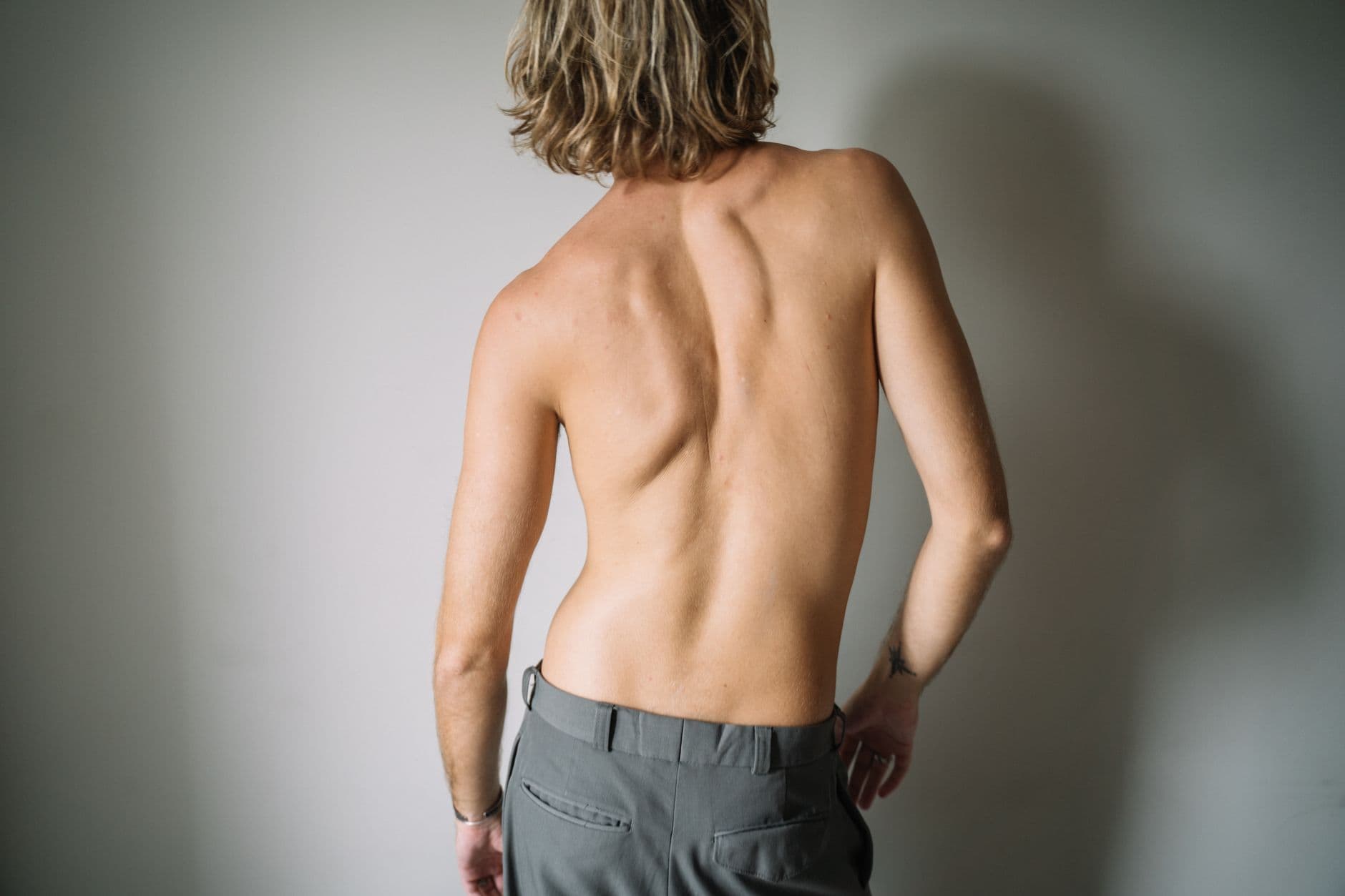
Scoliosis bends the spine sideways and also twists it slightly, which is why the signs show up in the shoulders, ribs, waist and hips and not only in the line of the back. Look for:
- One shoulder that sits higher than the other
- One shoulder blade that sticks out more than the other
- One side of the rib cage that looks more prominent
- A waistline that is uneven, or one hip that looks higher or more prominent
- Your head sitting off to one side of your pelvis instead of centered above it
- Clothes that hang unevenly, such as a hem that dips on one side or a strap that keeps slipping
Many people with scoliosis notice none of these, especially with a small curve. A mild curve is sometimes found by accident on an X-ray or scan taken for another reason.
A five-minute home check
You need a mirror or a helper, a phone for photos, and a spot where your back is visible. Wear something fitted, or no shirt, so the outline of your back is clear.
Step 1: Stand straight and compare sides
Stand with your feet together and your arms relaxed at your sides. Have your helper look at you from behind, or take a photo from behind. Compare the height of your shoulders, the position of each shoulder blade, the space between each arm and your body, and the height of your hips.
Step 2: The forward bend
Stand with your feet together and your knees straight. Bend forward slowly from the waist until your back is roughly parallel to the floor, with your arms hanging down and your palms together, as if you were about to dive into a pool. Ask your helper to look along your back from behind, and then from the side, at the level of your spine.
You are looking for one side of the rib cage or lower back that sits higher than the other, a ridge, or a lump. A back that looks even in this position is reassuring, but it does not rule out a small curve. A bump that shows up only when you bend is one of the classic findings that leads a doctor to order an X-ray.
Step 3: Take photos and keep them
Photograph your back standing and bent forward, from the same distance and in the same light. Photos let you compare in a few months, and they are useful to show a doctor.
Is it scoliosis or just posture?
Slouching or favoring one side can make your shoulders or hips look uneven, so it is fair to wonder whether you are seeing scoliosis or just posture. The difference is whether the curve is structural.
Unevenness that comes from slouching or favoring one side usually eases or disappears when you stand tall. Unevenness that comes from a difference in leg length usually eases when you sit down, because sitting levels the pelvis. Scoliosis is structural: the spine is curved and rotated, so the bump on one side of your back is still there when you bend forward. A difference in leg length can also cause a bump when you bend forward while standing, which is one reason this check can point to a curve that is not there.
That is a rule of thumb, not a diagnosis. If the unevenness is still there when you stand tall and when you bend, get it checked instead of assuming it is posture.
Does scoliosis hurt?
Often not, at least at first. Many people, especially those with mild curves, have no pain, so a pain-free back does not rule scoliosis out.
In adults, when pain does come, it is most often in the lower back, as an ache or stiffness that builds when you stand or walk. If the curve is narrowing the space around a nerve, you can also feel pain, numbness or tingling in a leg. That leg pain comes from the nerve, not the curve itself, and it is worth having examined. Back pain on its own has many causes, and why your back hurts and when to see a spine specialist covers the common ones.
If you are an adult: signs a curve is showing up later
Not every adult curve started in the teenage years. Some develop later in life as the discs and joints of the spine wear unevenly, which is called adult degenerative scoliosis. The signs usually arrive gradually:
- A slow lean to one side, or clothes that no longer fit the same way
- Back pain that builds when you stand or walk and eases when you sit
- Leg pain, numbness or tingling, often with walking
- Losing height
A curve you had as a teenager can also change as you age. Is scoliosis genetic? explains what a family history means, and scoliosis treatment for adults covers what treatment looks like once a curve has been found.
What confirms scoliosis
A doctor confirms scoliosis with a physical exam, which includes looking at your back standing and bending forward, and a standing X-ray of the spine. The X-ray lets the doctor measure the curve as a Cobb angle. A curve of 10 degrees or more is scoliosis, and the number is one input into whether the plan is to watch it, treat the pain, or look at surgery.
If you also have leg pain, numbness or weakness, your doctor may order an MRI. An X-ray shows the bones and the curve, and an MRI shows the discs and nerves, so the two answer different questions.
Already have a result? If a report gives your curve as a number of degrees, what degree of scoliosis requires surgery explains why the angle alone does not decide the next step.
Signs that should not wait
Some changes need a doctor soon, and a few need one now.
Go to an emergency room now if you have these
- New or rapidly worsening weakness in a leg
- Any change in bladder or bowel control
- Numbness in the groin or inner thighs
- Severe new pain after a fall, particularly with known low bone density
These are not wait-and-see symptoms.
See a spine specialist soon if you notice these
- A visible change in your posture, shoulder height, waistline or balance
- A ridge or lump on one side of your back when you bend forward
- Back pain that is steadily getting worse instead of coming and going
- Leg pain, numbness or tingling that worsens with walking and eases when you sit
When to see a spine specialist about a possible curve
See a spine specialist if your home check shows anything uneven, if back pain comes with a visible change in your posture, or if a scan has shown a curve and you want to know what it means. Mountain Spine's spine surgeons see adults with degenerative scoliosis, and the adult scoliosis page explains what a first visit covers. If your main problem is a back that hurts without a clear cause, the back pain page is the better place to start.
Bring your photos, any previous spine imaging and a note of when the symptoms started. If you already have an MRI, you can also send it in for an MRI review. When you are ready, request an appointment.
If you are worried about a child or teenager, start with their pediatrician. Curves in growing children are watched differently, and the right first step is a doctor who treats children.
Frequently Asked Questions
Answers to the most common patient questions about this topic.
How do you know if you have scoliosis?
Look for uneven shoulders, a shoulder blade or side of the rib cage that sticks out, an uneven waist or hips, and a bump on one side of your back when you bend forward. Those signs are a reason to get checked, not a diagnosis. Scoliosis is confirmed by an exam and a standing X-ray showing a curve of 10 degrees or more.
Can you have scoliosis without knowing it?
Yes. A mild curve often causes no pain and few visible changes, and some people first learn about one when an X-ray is taken for another reason.
Can you develop scoliosis as an adult?
Yes. As the discs and joints of the spine wear unevenly with age, the spine can start to curve, which is called adult degenerative scoliosis. A curve from the teenage years can also change in adulthood.
Does scoliosis always cause back pain?
No. Many people, especially with mild curves, have no pain. When adults do have pain, it is often a lower back ache that builds with standing or walking, sometimes with leg pain, numbness or tingling from a pinched nerve.
How common is scoliosis?
About 2 to 3 percent of teenagers have idiopathic scoliosis, and the same 2 to 3 percent is often quoted for the whole population, which in the United States is several million people. Studies of adults find higher rates, and the rate rises with age: in one study of adults aged 40 and older, about 9 percent had a curve of more than 10 degrees in the lower spine. Most curves are mild.
What causes scoliosis?
The most common type, idiopathic scoliosis, has no single known cause, and it often runs in families. Other types come from how the spine formed before birth, from a nerve or muscle condition, or from wear in adult spines.